
Case studies
GLCDI – Grazing Lands Carbon Data Initiative
Reconnecting democratic participation through interoperable digital infrastructures.
Client
Actors involved in soil carbon measurement and grazing management across diverse grazing systems.

Challenges
Grazing practices vary widely depending on local conditions and methods.
Soil carbon measurements are not consistently connected to management decisions.
Comparing outcomes across farms and regions remains difficult.
Collaboration requires shared data while preserving context, diversity, and trust.
Solution
A shared data space federating grazing management and soil carbon data.
An interoperable and governed framework connecting practices and measurements.
A foundation for collective learning, comparison, and long-term monitoring.
Results
A shared data space linking grazing practices and soil carbon data.
Improved comparability across farms while preserving local context.
A scalable and trusted foundation for long-term collaboration.
They work with us
Discover more about the project
What’s GLCDI?
The Grazing Lands Carbon Data Initiative (GLCDI) is a multistakeholder trust alliance and shared data space designed to federate soil organic carbon (SOC) and grazing management data across grazing lands.
GLCDI focuses on soil organic carbon as a primary indicator of soil health and aims to better connect on-the-ground grazing management practices with measurable soil outcomes. By bringing together producers, researchers, institutions, and technology partners, the initiative seeks to enable the secure sharing, analysis, and reuse of data while preserving data ownership and control.
Through this shared data space, GLCDI supports scientific analysis, predictive modeling, and the development of decision-support tools that inform the transition toward regenerative and adaptive grazing systems.
Challenges
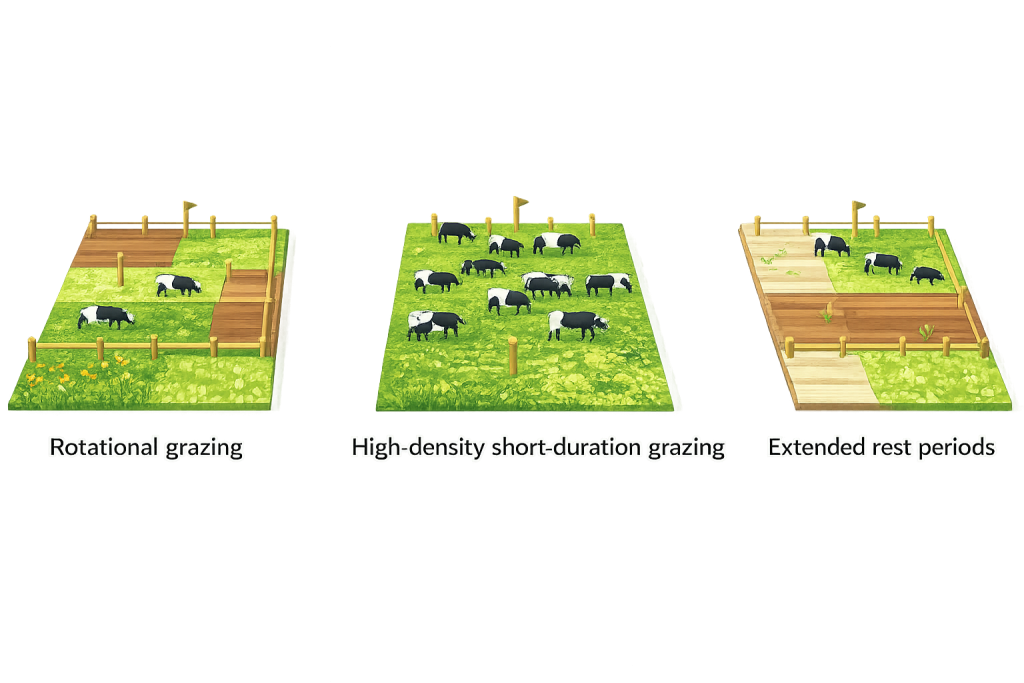
Farmers use a wide range of grazing management methods to adapt to their land, climate, and production constraints. These methods include rotational grazing, high-density short-duration grazing, extended rest periods, and other adaptive approaches that vary in timing, intensity, and frequency.
While these methods are widely promoted as “good practices”, their implementation differs significantly from one operation to another. Decisions are often based on experience, local knowledge, and regulatory or program requirements, rather than on clearly comparable evidence of soil outcomes.
This diversity of grazing methods creates several challenges:
- Grazing practices are applied differently depending on context, making results difficult to compare.
- Management choices are not always consistently documented or linked to soil carbon measurements.
- It remains difficult to assess how specific methods influence soil organic carbon over time.
- Farmers lack clear, shared feedback on how different grazing strategies perform across comparable conditions.
As a result, producers are encouraged to adopt certain grazing methods without always having access to data-driven insights that connect their management decisions to measurable soil outcomes.
Opportunities
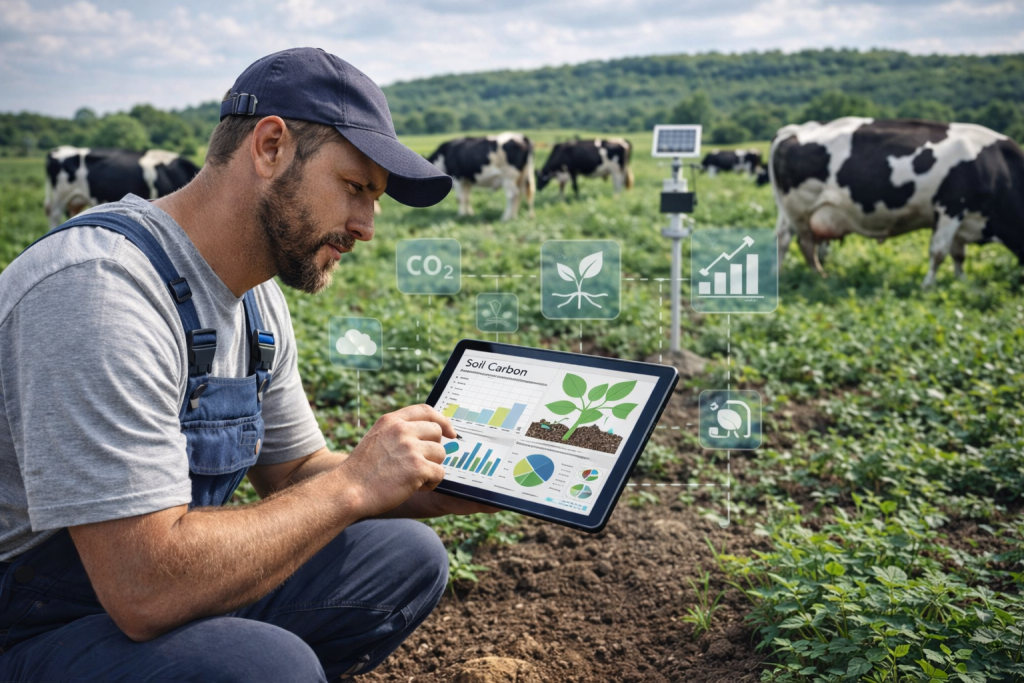
Despite these challenges, the growing availability of soil organic carbon data and grazing management records creates a significant opportunity. When these datasets are connected, they make it possible to better understand how different grazing methods influence soil outcomes over time and across comparable contexts.
Linking management practices with soil carbon measurements opens the door to clearer, data-driven insights into regenerative and adaptive grazing strategies. It allows outcomes to be compared across farms and regions, supports scientific analysis and predictive modeling, and helps translate research findings into practical, on-the-ground guidance. These opportunities also increase confidence for institutions, programs, and investors seeking to support grazing systems that demonstrate measurable environmental impact.
Realizing this potential, however, requires trusted data-sharing mechanisms that preserve data ownership, respect local autonomy, and ensure that insights remain grounded in real-world farming conditions.
Solutions
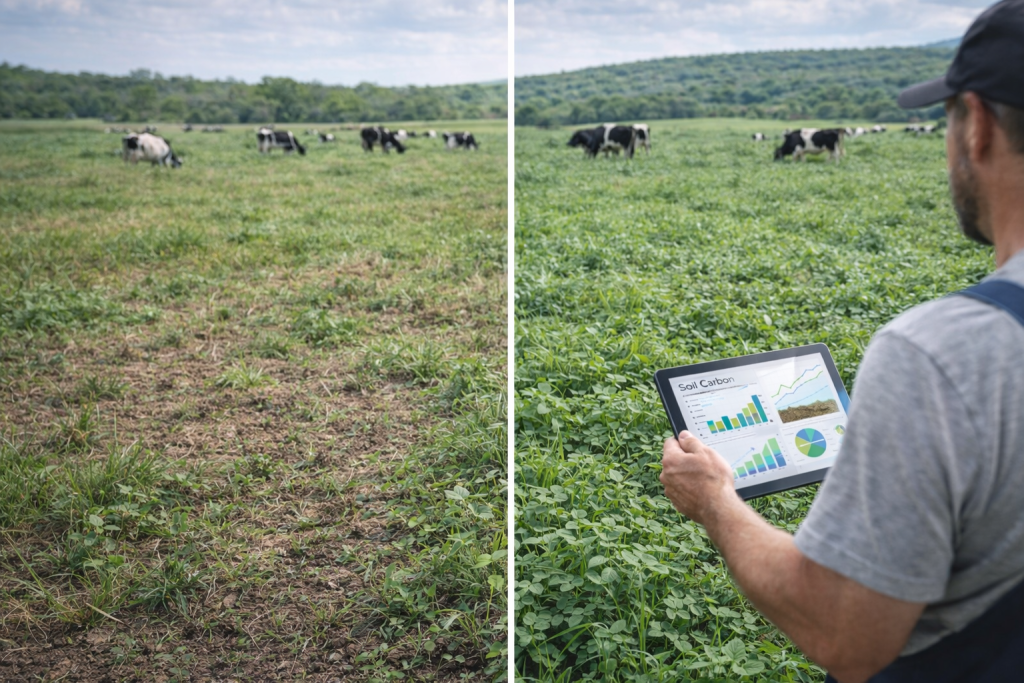
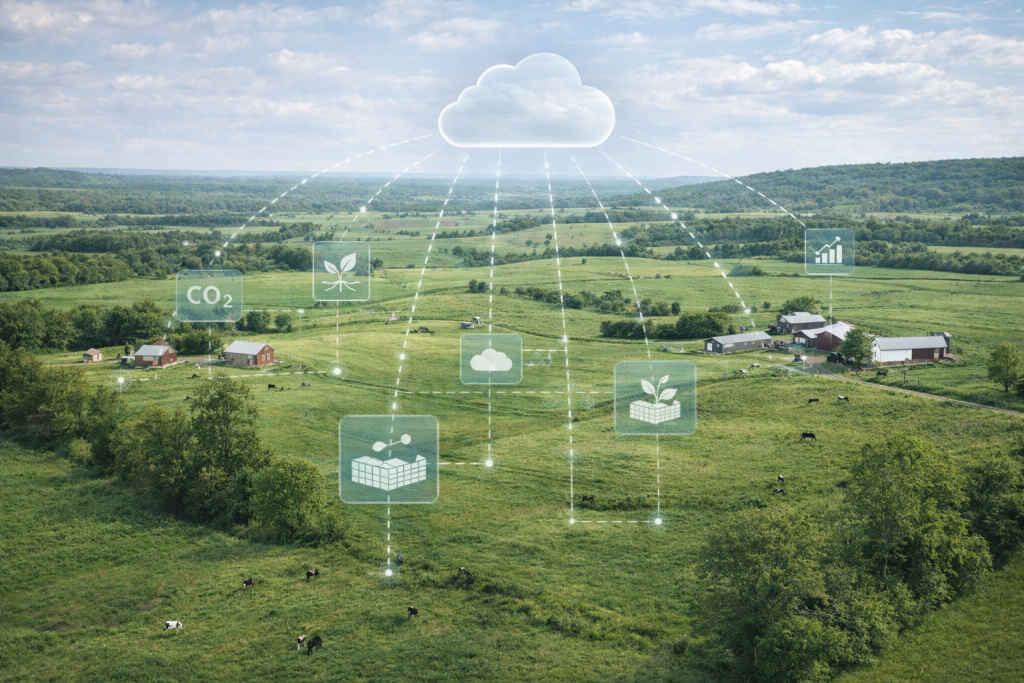
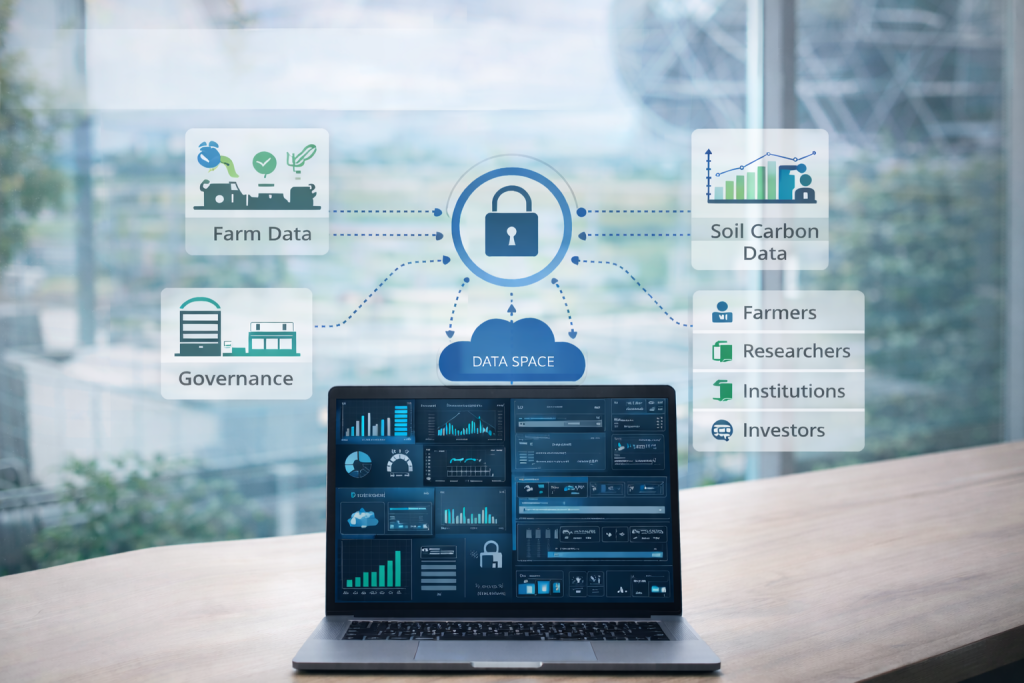
GLCDI (Grazing Lands Carbon Data Initiative) addresses these needs by building a shared, permissioned data space that federates soil organic carbon and grazing management data across grazing lands. Rather than centralizing data, the initiative enables participants to securely share, analyze, and reuse information while maintaining control over their datasets.
Through this data space, GLCDI integrates existing soil carbon measurements with detailed grazing management records, using common vocabularies to describe grazing events, soil indicators, and regional context. This integrated approach supports scientific analysis, feeds predictive models, and enables the development of decision-support tools that translate analytical results into practical insights for producers.
By connecting data to real management practices, GLCDI helps ensure that insights remain relevant to on-the-ground decision-making, while also enabling broader comparison and learning across grazing systems.
“This work is creating systems of trust for farmers to share data and for farmers to have sovereignty over their data,”
Kara Weinstein
The role of Startin’blox
Startin’Blox acts as a technical partner supporting the design, deployment, and incubation of the GLCDI data space. Its role is to provide the digital foundations that enable secure, interoperable, and trusted collaboration among participants.
Startin’Blox supports organizations in entering the data space by helping them connect their existing systems, align their data with shared standards, and adopt the governance and interoperability frameworks required to participate. This onboarding role helps reduce technical and organizational barriers for producers, researchers, and technology providers engaging in the initiative.
In addition, Startin’Blox contributes to the incubation of the data space by supporting its early-stage operation, evolution, and scalability. This includes assisting with infrastructure design, interoperability mechanisms, and governance implementation, ensuring that the data space can grow over time while preserving data ownership, control, and trust among participants.
Let’s talk!
Transform data into business value
Let’s explore how data from your ecosystem can become a source of value for your business.
Featured Cases

B2B tech launch
Go-to-market strategy for B2B product

Retail reset
Business model reset for retail chain

Supply chain process redesign
Operational efficiency boost for logistics company

Core systems overhaul
Digital transformation for regional bank

Digital product launch
Go-to-market strategy for digital product

Monetisation strategy